Showing posts with label What is Trig?. Show all posts

Sunday, November 6, 2016

4.4- Graphing sin and cosine functions


something that you have to know is...
this formula is 
so important if you want to understand the next step

How to define period, amplitude, phase shift and vertical shift of a periodic function?'

Period--- When does it start to repeat? For instance, for period of sin(x) is 2*pi because it repeats every 2*pi. 

Amplitude--- How high does the graph go? In other words, the maximum value minus the minimum value. For instance, the amplitude of sin(x) is 2 because it goes from 1 to -1. 

Phase Shift--- How far is the graph shifted over to the right? For example, the phase shift of sin(x) is 0 because it is not moved at all in the x direction. 

Vertical Shift--- How far is the graph shifted up? For example, the vertical shift of sin(x) +1 is 1 because the graph is shifted up 1 unit of sin(x).


4.3 Trig Functions of a Unit Circle

1 What is trigonometry?

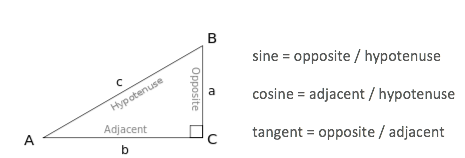
Trig mnemonics like SOH-CAH-TOA focus on computations, not concepts:
body proportions
TOA explains the tangent about as well as  describes a circle. Sure, if you’re a math robot, an equation is enough. The rest of us, with organic brains half-dedicated to vision processing, seem to enjoy imagery. And “TOA” evokes the stunning beauty of an abstract ratio.
Trigonometry ... is all about triangles.It also helps with circles, finding angles and distances in many shapes, coding in video games, and more!
Trigonometry is the branch of mathematics that studies triangles and cycles. Trigonometric functions are used to describe properties of any angle, relationships in any triangle, and the graphs of any recurring cycle. Learning trigonometry will help you understand visualize and graph these relationships and cycles. If you combine studying on your own with staying focused in class, you’ll grasp the basic trigonometric concepts and likely start noticing cycles in the world around you.

4.2-Degrees and Radians


Radians and degrees are two units for measuring angles.


Degrees

Degrees are used to measure direction and angle size. If you are facing north, you are said to be at 0°. If you turn the opposite direction to face south, you have turned 180°.
A full circle is comprised of 360°. 

Radians

The formal definition of a radian is that a radian is the measure of an angle that, when drawn as a central angle of a circle, intercepts an arc whose length is equal to the length of the radius of the circle. The radian measure for a full circle is 2π. This might look even messier than 360°, but if you follow through on the math, it actually works out. If you remember, the equation for finding the circumference (C) of a circle with radius (r) is C = 2πr. If r = 1, then C = 2π. FIr this reason, 2π is equal to one full revolution around a circle or 360°A circle with a radius of 1 is called a Unit Circle.
Some examples

4.6- Inverse Trig Functions


You need to memorize this chart
looks more difficult mentally  but is like
Yea, i know,.. its hard... im sorry
The general rule is, we always use Quadrant I, where cosine, sine, and tangent are all positive. 
Then we want another adjacent quadrant (so the domain can be continuous) that gives us the negatives values. 

Which quadrant to pick is obvious for sine and cosine. 

Sine is still positive in Quadrant II, but negative in Quadrant IV. 
So for inverse sine, we need Quadrant I and Quadrant IV, 
and we have a domain that ranges from -1 to 1. 

Cosine is positive in Quadrant IV, but negative in Quadrant II. 
So for inverse cosine, we need Quadrant I and Quadrant II, 
and we have a domain that ranges from -1 to 1. 

Which quadrant to pick for tangent requires one more consideration. 

From -π/2 to 0 (Quadrant IV), tangent is between -infinity (undefined) and 0. 
From 0 to π/2 (Quadrant I), tangent is between 0 and infinity (undefined). 
From π/2 to π (Quadrant II), tangent is between infinity (undefined) and 0. 

So, for inverse tangent: 
Using Quadrants IV and I results in a continuous domain from -infinity to 0 to infinity. 
Using Quadrants I and II results in a broken domain at the transition from Quadrant I to II. 

So we pick Quadrants IV and I for inverse tangent. 

Summary: 
If the value is positive, inverse sine/cosine/tangent will be in Quadrant I. 
If the value is negative, inverse cosine will be in Quadrant II. 
If the value is negative, inverse sine/tangent will be in Quadrant IV.

4.5- Graphing other Trig functions

You have to know how to differentiate cos, sen and tan in a graph
so...
is easy cause sen,tan and cos are so different...well cos and  sine no is almost the same.
(look like)

now

if you put all the data together, you can easily find these answers.